
Wit beer is close to my heart. In ages past it was the most common beer in the area where I grew up in. So when two Dallas breweries have a wit beer in their offering, we had to get our hands on some and do a quick match-up between these two creations. I got some friends together and have them do a compare and contrast tasting. Let’s see who took the win.
Wit beer is a wheat beer originating from central Belgium. In the 18th and 19th centuries a very popular beer was the so called “biere blanche de Louvain” with more than 30,000 tonnes (approximately 6,400 bbl) shipped annually. Besides being made in Leuven, my hometown, another village about 15 miles Southeast made a wit beer which would later become the cradle of the wit beer resurgence. After the second world war, and with the increased popularity of lagers and pilsners, wit beer all but disappeared. In Hoegaarden the last brewery closed its doors in 1956 and in Leuven brewery De Eendracht, who made a wit beer named Peeterman, closes its doors in 1974.
In the mean time however, a milkman named Pierre Celis, decided to recreate the wit beer style in his hometown of Hoegaarden. This has now become the standard by which all other wit beers are measured. The original wit beer was most likely more sour than what we currently associate with the style. Today most wit beers are cloudy, a little citrusy and refreshing. Hops should not be overbearing and it should sport a dense white head.
So how do Deep Ellum Brewing Company’s “Farmhouse Wit” and Community Brewing’s “Wit” stack up against each other and the style ? In all fairness, Deep Ellum does not promote its “Farmhouse Wit” as a true wit beer. It describes it as something in the middle of a saison and a wit beer.
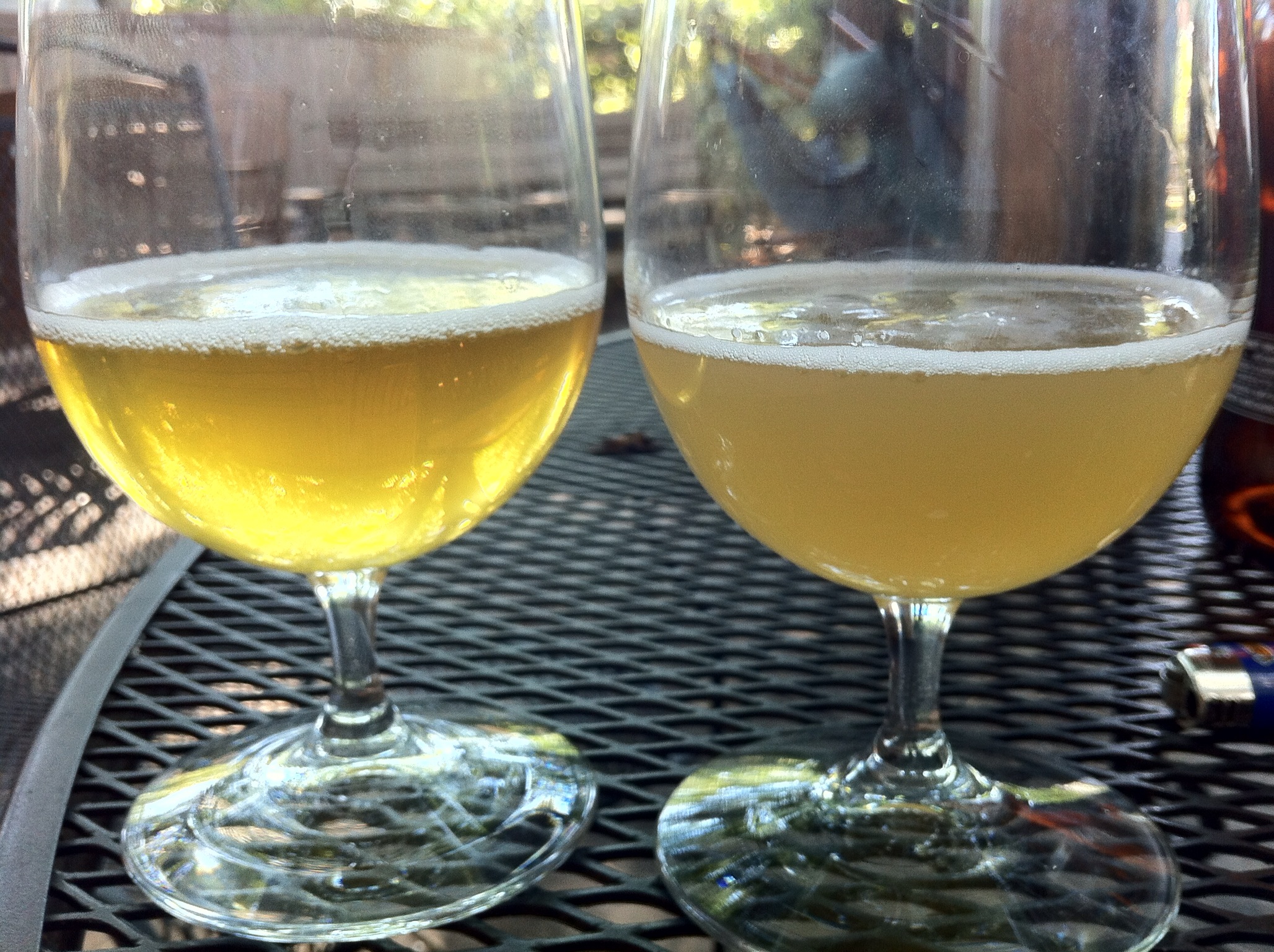
Left:Farmhouse Wit / Right:Community Wit
At first pour, the one thing that immediately sets the two apart is the color and cloudiness. Or in Deep Ellum’s case, the lack thereof. Farmhouse Wit pours clear into the glass, with a very fine champagne like bubble, betraying its nature as a saison more so than a wit. Community wit poured with a thick head, cloudy and the banana aroma associated with wheat beers was clearly there though not overwhelming.
As we enjoyed the beers, one of my friends remarked that “The Farmhouse is a good beer, but I’m not sure what to make of it. It’s not a wit, and not really a saison either“. And I think that really sums up how these two compare. In all honesty they don’t. Community Wit a true example of an excellent witbier. Probably one of the best I have had since Pierre Celis stopped brewing. It is very reminiscent of the original Hoegaarden as it was brewed before it got taken over by the Belgo-Brazilian behemoth. It was crisp, a little citrusy, chewy and yet very refreshing. It had nothing of the coriander-orange peel soups that are being labeled as wit beers but have more resemblance to some spice concoction that a true wit beer.
Both of my friends agreed. They liked Farmhouse Wit as an OK beer. Not something they would necessary purchase again. It was a little much on the hoppy side to be a wit. Not enough of the famous funk for it to be a good saison. The Community Brewing Wit however was a success for both of them. They asked where they could get it, whether it was bottled yet and they decidedly wanted me to call them next time I got my hands on a growler or two. We all agreed it they had a well deserved silver medal in the Wit category at the recent U.S. Open Beer championships. If you want a solid example of what a true wit should taste like, I can highly recommend getting your hands on some Community Brewing Wit. The clear winner in this brew-off:
 |
– | |
| Community Wit: 3 | – | Deep Ellum Farmhouse Wit: 0 |