Ah the world of IPA’s. For the uninitiated, IPA stands for Imperial Pale Ale and are basically hoppier versions of English Pale Ale style beers. For those familiar with the style, they evoque memories of hoppy, piney, spicy, resiny goodness.
Nowadays, it appears that every self-respecting craft brewery has at least one IPA on their list and hence we thought it was about time we started putting the Dallas area IPA’s in a little blind taste test.
We decided to start this brew-off with an IPA of the three oldest Dallas breweries. So that would mean the venerable Rahr & Sons, and then the two breweries who gave the Dallas craft beer scene their impetus two years ago. Deep Ellum Brewing Company and Lakewood Brewing Company. We would have obviously included the second oldest brewery, Franconia, where it not that they don’t have an IPA in their offering. Or we should say “Not Yet” if we rely on the recent TABC label approval news we’re seeing.
So here are the contenders from left to right: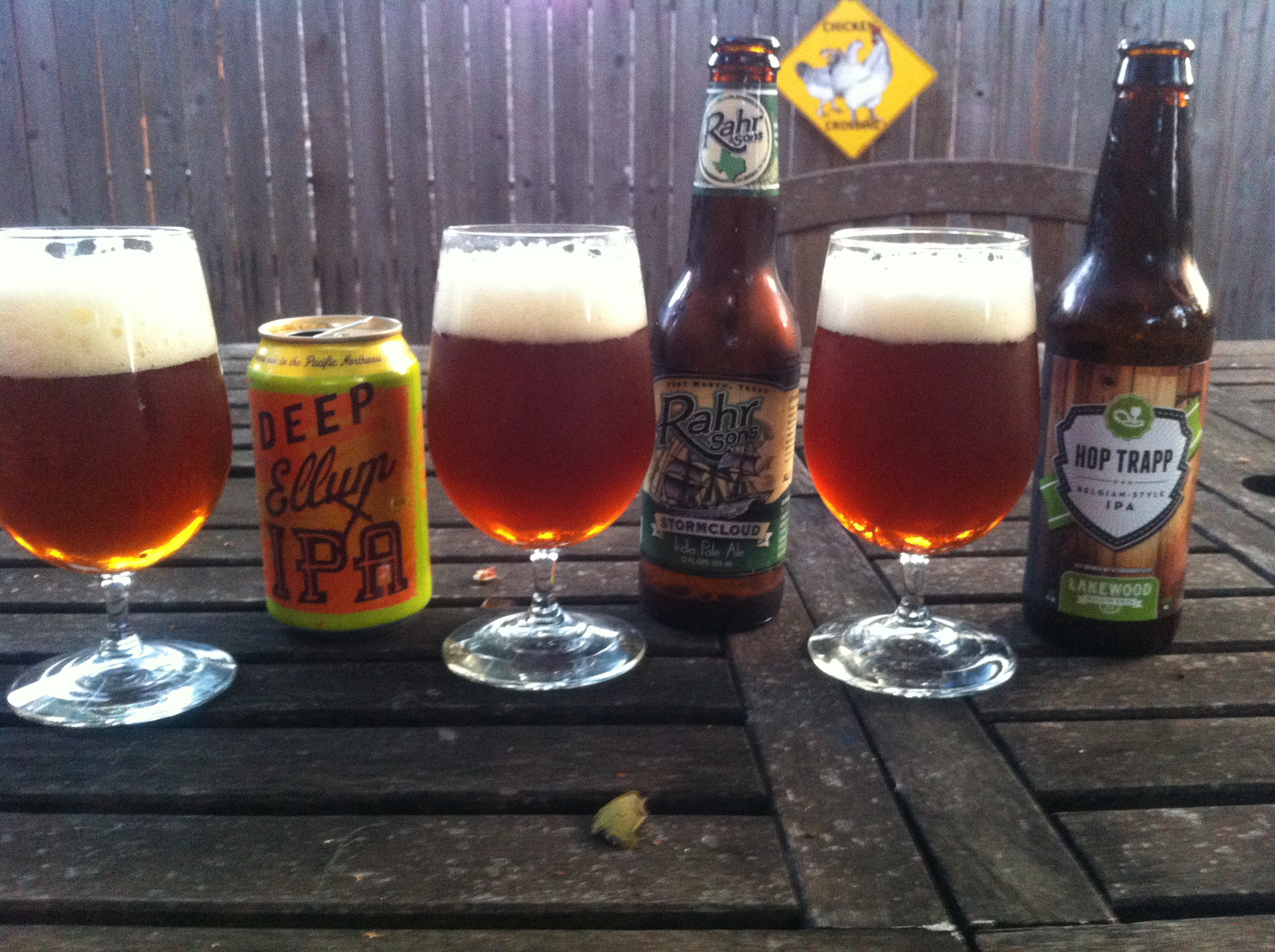
- Deep Ellum: IPA – Glass #1
- Rahr & Sons: Stormcloud – Glass #2
- Lakewood: Hop Trapp – Glass #3
But before we start the inherently subjective taste comparisons, here are some numbers. Bitterness is often measured in a standard called IBU (International Bitterness Units). Lakewood is the lightweight with 55 IBU reported on the label. Deep Ellum and Rahr & Sons both report their IBU’s in the 70’s range. Keep this number in mind, you’ll see why a little further down.
Pouring the three beers in an identical glass, the Stormcloud and Hop Trapp show a very similar reddish brown hue, while the DEBC IPA is several tints darker in appearance. We then, for obvious reasons, removed the bottles and cans to invite our panelists to the blind taste test. Here are their notes and comments
Panelist 1:
When I drink an IPA, I want in your face hops. I want to taste the hops, I want the sense of bitterness. The only one of the three I really got that sense from was glass #1. The other two were fairly identical with #3 showing a little more hoppyness. Therefore I ranked glass #1 the highest, followed by glass #3 then glass #2
Panelist 2:
IPA’s are my stand-by beer. There’s always some in my fridge from one brewery or another. However, it needs to remain a beer that’s fairly drinkable. Or “quaffable” is probably a better term. I don’t tend to gravitate towards those IPA’s that are so bitter one cannot drink more than one without feeling like you bit into a pine tree. My order would be #1 as it had that nice bitter hoppyness, with just enough resin to linger. Followed by #3, which is very well balanced, and finish with #2, which was just too sweet for my liking.
Panelist 3:
I love IPA’s. However what I have found is that most breweries go completely overboard on the piney character of their beer. A good IPA has a balance between the hoppy bitterness and maltiness. A perfectly balanced IPA is hard to achieve and I feel that those that go overboard on the hops are perhaps trying to hide other flaws in their product. Once you cover all other flavors with resin, piney and citrus flavors, one tends to lose the balance in the beer. My ranking is #3, #1 and then #2. I just found #2 too much malt forward for an IPA.
Panelist 4:
I tend to gravitate toward the more malty and sweet beers. That probably makes me a bad panelist for an IPA blind tasting. I’m just not really fond of overly bitter or hoppy beers. I liked #2 the best, followed by #3 and #1.
Before we get to the tally of the score, notice how glass #2 (the Rahr & Sons Stormcloud) was perceived as malty or sweet by some of panelists. And yet, based on the numbers we have, it has a higher IBU value than glass #3 (Lakewood’s Hop Trapp) and more in the range of glass #1 (DEBC IPA). It highlights one of the most important aspects of creating good beer: balance ! It is all about achieving a good balance between the malts, hops and yeast used in the brewing process. Sweetness extracted from the malt can offset high bitterness delivered by the hops.
In addition, what we perceive as “bitter” in IPA’s, is not just a bitterness. It is usually a combination of flavors, including pine, resin, citrus or fruit flavors. We tend to associate citrus and pine flavors with IPA’s. And they have more to do with the aromatic characteristics of the hops used, than with their actual bittering power. As Deep Ellum uses more of the hops commonly associated with a citrus flavor profile, such as Simcoe and Citra, it’s tends to meet the expectations of those looking for those pine like flavors in their IPA’s.
But enough about beer flavor profiles, malts and hops. Here’s the tally:
Deep Ellum
|
Rahr & Sons
|
Lakewood
|
|
Panelist 1 |
 |
|
|
Panelist 2 |
|
|
|
Panelist 3 |
|
|
|
Panelist 4 |
|
|
|
9 |
6 |
9 |
It appears we have a tie. And yet, we can still derive some recommendations or conclusions from this. Even though Deep Ellum’s IPA and Lakewood’s Hop Trapp scored the same points, from the comments of our esteemed panelists, we can conclude that for those that like “in your face hops“, the Deep Ellum IPA is likely to be a beer more pleasing to your taste buds. While for those preferring a more balanced IPA, Lakewood’s Hop Trapp may be more up your alley.
Part 2 featuring some more Dallas IPA’s to follow soon. After all, it appears every brewer has at least one IPA (or Imperial Red Ale) up their proverbial sleeve.