
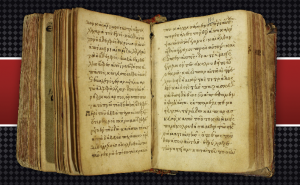
 Last Saturday I was one of the lucky. Seated amongst a 1,600 member audience, I was able to attend the SMU debate on the reliability of the New Testament between Dr. Bart Ehrman and Dr. Dan Wallace. With a title like “Can we trust the text of the New Testament”, I was looking forward to a spirited debate between two esteemed and reputable scholars in the field.
Considering this is a short blog entry, I will not spend too much time introducing both scholars. You can find Dr. Ehrman’s bio here and Dr. Wallace’s here. Suffice it to say that both can produce an impressive resume on NT textual criticism. Dr. Ehrman is on the non-believer side of the spectrum, while Dr. Wallace considers himself, as he had to point out during the debate while refuting a member of the audience, “an Evangelical Christian, not a fundamentalist”.
So what about the debate itself ?
The course of the debate was overall pretty scripted. Dr. Ehrman was given thirty minutes to present his perspective, followed by Dr. Wallace doing the same. Two short sessions with questions and answers back and forth in the same format was followed by questions from the audience and closing arguments.
Dr. Ehrman opened with the question “How many people are here to see me get creamed”, which drew the obligatory chuckle from the audience. An eloquent speaker, he was obviously able to set a lighter tone as he iterated his mantra “copies of copies of copies of copies”. He then presented his arguments concisely to conclude that “We can’t know for sure that the text we have today corresponds to the originals”.
Dr. Wallace then, congratulated Ehrman with his list of bestsellers and was noticeable sticking more to his notes and presentation. Although he was able to keep the rhythm and engage the crowd, even as the remote to progress the slides went flying across the stage. He presented more statistical arguments such as the types of discrepancies, the sheer number of NT manuscripts compared to those for other works from antiquity and emphasized that we can’t fall into neither radical skepticism nor absolute certainty.
As I have followed both Ehrman and Wallace for a while now, I have to say I was overall somewhat disappointed with the presented arguments. Dr. Ehrman repeated his now familiar position that we don’t have any autographs (eg. original manuscripts) of the New Testament writings and therefore we cannot be assured that the writings we do have reflect the original. Dr. Wallace provided the well known arguments that we have more extant manuscripts of the New Testamental writings than for any other work out of antiquity, and that we therefore can conclude with reasonable probability that we can rest assured the current text closely matches the original. Personally, very little new information for me to digest. Although I am sure it was quite edifying and very well presented for those less familiar with the domain.
The two scholars did show some agreement as well with regards to the differences we do find across the many manuscripts in existence. For let us not fool ourselves. There are differences in the extant manuscripts. They concurred that the majority of differences, which may total as much as 400,000 while the NT only contains a total of about 140,000 words, are non-consequential. Many are either misspellings, grammatical mistakes, or other. They also agreed on the dubious nature of certain passages such as the longer ending of Mark or the passage about the adulterous woman found in John 7:53-8:11. And they also agreed that none of the discrepancies fundamentally alter the theological ideas currently found in our New Testament. Dr. Ehrman’s position is that this doesn’t mean the current text really reflects what the original writers wrote down or recorded. Dr. Wallace will argue there’s sufficient probability to accept that it does.
What was refreshing is to find two distinguished scholars in this area interact amicably. Contrary to the heated and very polarizing polemic one can find on the internet blogosphere, these two very erudite and educated scholars demonstrated professional respect and understanding. In addition, the moderator did an excellent job of curtailing any emotional, instigating and, in my opinion, ridiculously off-topic questions such as “Do you believe in the virgin birth” or “Do you think the writers of the manuscripts were the same people that condemned Galileo”. To Dr. Ehrman’s credit, he quickly dispatched a question, which I think was addressed to Dr. Wallace, and which referenced the popular yet false idea that the council of Nicea created the scriptural canon. Dr. Ehrman showed his true academic nature and spirit by quickly dismissing this populistic yet inaccurate belief, propagated by the writings the like of the Da Vinci Code, even though it was not directly addressed to him. Hats off to thee, Dr. Ehrman.
With the exception of these aberrant interruptions, we also enjoyed some good questions. Let me highlight two, which I will have to paraphrase until the DVD recording is available. The first question was addressed to Dr. Ehrman. The member of the audience asked “Given that we don’t have any autographs, what would it take for you to trust the text of the New Testament ?”. Dr. Ehrman responded that if we had perhaps ten copies that were proven to be a first generation copy, and that if they were 99% aligned, he would revisit his position on the trustworthiness of the current text. The second excellent question, addressed to Dr. Wallace, was from an attendee who grew up in a King James only environment. She asked which Bible translations Dr. Wallace could recommend as a good balance between readability and accuracy. He recommended several, amongst which the TNIV, NRSV and obviously the NET translation. For those struggling to find a good Bible translation, this was undoubtedly helpful.
But outside of the questions posed by the audience, there was little intellectual sparring between the two distinguished professors. They re-iterated positions and arguments that are quite familiar for those that have been following the ongoing discussions, and the scripted format allowed for little live interaction and commentary.
One suggestion for a future debate would be perhaps to collect questions from the attendees in advance, perhaps during ticket purchase, and let the debate participants answer each question in turn. I feel this might have led to a more interactive dialogue of argument and counter-argument. It would have had the potential to be more educational than the current approach taken by the organizers.
Personally, for me the main take away was this. Dr. Wallace made the same, although very subtle, point twice during his presentations. Dr. Ehrman is known for his writings and critique on the text of the New Testament and his position that the texts are not the original accounts and were either manipulated for theological purposes (Misquoting Jesus) or written by others than we think they were (Forged: Writing in the Name of God–Why the Bible’s Authors Are Not Who We Think They Are). Dr. Wallace asked the question how Dr. Ehrman could be so sure of this position ? If one can claim that “So-and-so did not write this”, wouldn’t we need a proven writing of the same author to compare it against ? If one claims that the message was distorted, wouldn’t we need to know what the original message really was ?
For instance, if a thousand years from now, one would find a New York Times article claiming three towers fell on September 11th 2001, the only way we would know this was not a valid New York Times article, is if we could compare it to a real one. Perhaps compare font setting, or logo, or the paper it was printed on. And the only way we would know that it was two and not three towers, is if we would know for a fact there were only two towers in existence. One has to be certain of the original story and the original publisher or writer, to be able to emphatically posit that the story in our hands is not accurate. Considering Dr. Ehrman’s position that we can’t reliably reconstruct the original text, stories or writers, do we then have a foundation to compare them to ? That provided me some solid food for thought while reading through Dr. Ehrman’s latest writings.
Back to the question the debate was trying to answer: “Can we trust the text of the New Testament ?”. Considering we lack a true autographic copy to substantiate either side, yet we do possess a large variety of existing manuscripts that have quite a lot in common, a more balanced and less, to use the words of the member of the audience, “fundamentalist” approach would be indeed to say that “For all purposes, we have sufficient probability to say that the text reflects the original writings”. Absolute proof ? No. I tend to concur with Dr. Ehrman from a pure academic and technical position. But that wasn’t the question. The question was whether we can trust that the text we have is close enough. For Dr. Ehrman, trust requires absolute proof. For Dr. Wallace, high probability. And in my humble opinion, that is where Dr. Wallace showed the more academic balanced approach of the two last Saturday. We deal with high probabilities all the time. Absolute repeatable proof is not something we can consistently apply to history. If we cannot accept history based on sufficient probability, Dr. Wallace pointed out we would end up back in the dark ages where we knew nothing. And I for one, am not willing to go there. The level of probability we have to trust the text of the New Testament, is sufficient enough for me. And if that puts me in the excellent company of Dr. Wallace, well, that’s just a bonus to boot.
One Response to SMU Debate review. Can we trust the text of the New Testament